
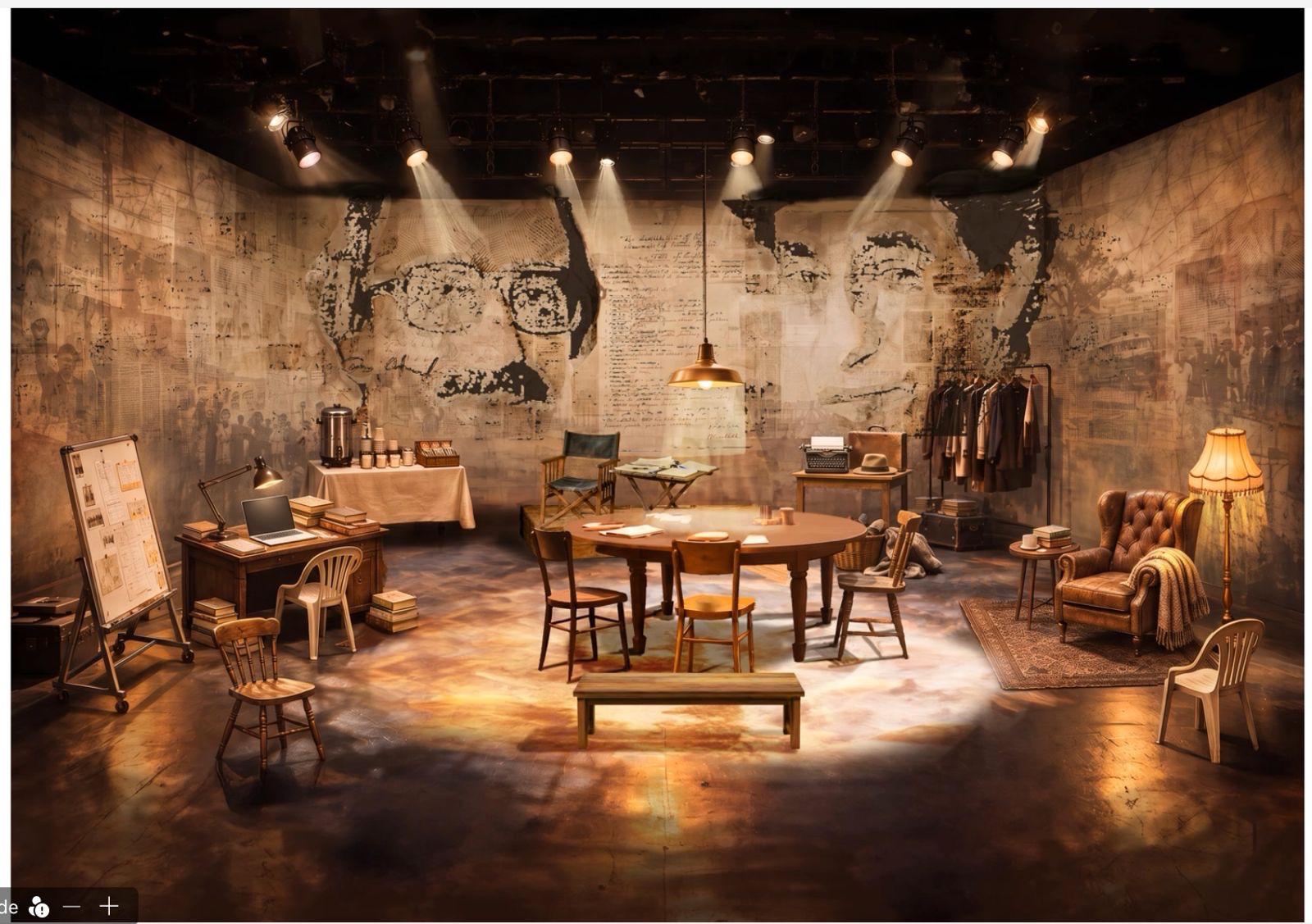
The Market Theatre and Fishamble, with support from The Embassy of Ireland in South Africa, proudly present Kader Asmal’s Table, a brand new historical drama by acclaimed Irish playwright, Colin Murphy.
This play-within-a-play offers a fictional account of the true story behind the origins of the Bill of Rights as enshrined in South Africa’s Constitution, and explores the legacy of this moment 30 years since its adoption.
The production is made possible through support from The Embassy of Ireland in South Africa and will run from 25 November – 13 December 2026 at The Market Theatre as an anchor piece for Common Ground, a flagship cultural project of the Irish Presidency of the Council of the EU.
The play revisits a rainy Dublin (Ireland) weekend in 1988 when human rights activists Kader Asmal and Albie Sachs were tasked by OR Tambo and the ANC to begin the process of writing the Bill of Rights for a yet to be realised dream of a new and liberated South Africa, which they – alongside many others – had dedicated their lives to fighting for. This weekend occurs shortly after Albie Sachs survived a car bomb in Mozambique, losing his right arm and sight in one eye.
Author’s note
This play is not a history play. It is a work of imagination, inspired by a moment in history: the moment when Albie Sachs and Kader Asmal met at Kader’s home, in Dublin, in 1988, to draft a bill of rights.
That moment has been documented by Albie Sachs, in his writings and talks, by Kader Asmal, in his memoir, and in particular by the historian, André Odendaal, in his book, Dear Comrade President: Oliver Tambo and the Foundations of South Africa’s Constitution. I was privileged to visit Albie, who shared generously of his time, memories and analysis, as did Kader’s sons, Adam and Rafiq.
However – and helpfully, for the purposes of making a play – the written records of that 1988 meeting have been lost along the way. I have used this to take licence to imagine a theatre company in today’s South Africa who are themselves trying to imagine the events in 1988. So this is a fiction, inspired by fact.
I have previously written a series of plays dealing in different ways with Irish history. Each has navigated this path between fact and fiction differently. But all have this in common with this play: many of the best lines were not written by me. In this case, they come from a number of different sources: from Albie’s and Kader’s own words; from the various authorities who shared their insights, analysis and memories with me; from the academic sources I consulted; and from the workshop that we held at the Market Theatre.
The idea for the play came from my old friend, and one-time journalistic colleague, Riyaz Patel, who then introduced me to the Irish Embassy, who have made this all possible. I had the opportunity to do research in Cape Town, thanks to the Maxeke-Robinson Research Chair at UWC (which was itself thanks to the Rooney Writer Fellowship at Trinity Long Room Hub).
In Ireland, I developed the play with the support of my regular collaborators, Fishamble: the New Play Company, and director-dramaturg Conall Morrison. The following all participated incisively in workshops there: Morgan Jones, Ali White, Shadaan Felfeli, Aoife Spillane-Hinks, Ruth Hegarty, Daniel Gilligan, Neil McCarthy, Jolly Abraham, Jonathan White, and our old friend Mr Clunk.
The final stage of development was a workshop at the Market Theatre, with this director and cast, and with the dramaturgical input of Greg Homann. To work on a script with such a talented, experienced and generous company, in such a storied venue, was a career highlight.
This play is dedicated to the memory of Mama Connie, who welcomed me into her home when I first lived in Johannesburg, and to Prof Tom Lodge, who welcomed me into his department at Wits.
Thank you to the following, who gave generously of their time and insights, or supported my work on the play in other ways:
Allan Taylor; Brendan Kelly; Caitriona Curtis; Cathal Digan; David Kinley; Dennis Davis; Eugene Downes; Jim Chandler; Joel Modiri; John Comaroff; Justice Dikgang Moseneke; Justice Kate O’Regan; Kabelo Mosate; Lawson Naidoo; Maurits Van Bever Donker; Neil Richards; Palesa Letlaka; Pallo Jordan; Patrick Geoghegan; Premesh Lalu; Rafiq Asmal; Rebecca Pursell; Reinhold Martin; Ruth Hegarty; Roger Field; Rucera Seethal; Vanessa & Oliver Sachs, Vince McCarthy, MacGill Summer School; William Binchy; Zack, Iseult & Elena Murphy.
SELECT BIBLIOGRAPHY
Asmal, Kader. “1916 and 20th Century Freedom Movements.” The United Irishman, July 1966.
Asmal, Kader. Victims, Survivors and Citizens: Human Rights, Reparations and Reconciliation. University of the Western Cape, 1992.
Asmal, Kader, and Adrian Hadland, with Moira Levy. Kader Asmal: Politics in My Blood: A Memoir. Auckland Park: Jacana, 2011.
Asmal, Kader, Louise Asmal, and Ronald Suresh Roberts. Reconciliation through Truth: A Reckoning of Apartheid’s Criminal Governance. 2nd ed. Cape Town: David Philip, 1997.
Battersby, John D. “South Africa’s Curbs Harden Rebels.” New York Times, June 7, 1988.
Callinicos, Luli. Oliver Tambo: Beyond the Engeli Mountains. Cape Town: David Philip, 2004.
Chantiluke, Roseanne, Brian Kwoba, and Athinangamso Nkopo, eds. Rhodes Must Fall: The Struggle to Decolonise the Racist Heart of Empire. London: Zed Books, 2018.
Chigumadzi, Panashe. “The Land Question.” Boston Review, Fall 2025.
Chinguno, Crispen, et al. Rioting and Writing: Diaries of Wits Fallists. Johannesburg: SWOP, 2017.
Fairbanks, Eve. “The Birth of Rhodes Must Fall.” The Guardian, November 18, 2015.
Gevisser, Mark. A Legacy of Liberation: Thabo Mbeki and the Future of the South African Dream. New York: Palgrave Macmillan, 2009.
Habib, Adam. “Maximalism Must Fall.” The Ideas Letter, April 16, 2026.
Johns, Sheridan, and R. Hunt Davis Jr., eds. Mandela, Tambo, and the African National Congress: The Struggle Against Apartheid, 1948–1990. New York: Oxford University Press, 1991.
Jordan, Z. Pallo. Letters to My Comrades: Interventions & Excursions. Jacana, 2017.
Maharaj, Mac, and Z. Pallo Jordan. Breakthrough: The Struggles and Secret Talks That Brought Apartheid South Africa to the Negotiating Table. Cape Town: Penguin Books, 2021.
Mamdani, Mahmood. “Beyond Nuremberg: The Historical Significance of the Post-Apartheid Transition in South Africa.” Politics & Society, 2015.
Modiri, Joel M. “Against Constitutional Worship in Post-1994 Jurisprudence.” In Perspectives on Legal Education from South Africa and Beyond, edited by Geo Quinot. (Stellenbosch University Faculty of Law book series) LexisNexis, 2026
Moseneke, Dikgang. My Own Liberator: A Memoir. Johannesburg: Picador Africa, 2016.
Murphy, Colin. “‘The Less You Have Actual Power, the More Incestuous the Battles Are’: Kader Asmal Talks to Colin Murphy.” Village, March 22, 2006.
Odendaal, André. Dear Comrade President: Oliver Tambo and the Foundations of South Africa’s Constitution. Cape Town: Penguin Books, 2022.
Sachs, Albie. Advancing Human Rights in South Africa. Cape Town: Oxford University Press, 1992.
———. The Jail Diary of Albie Sachs. London: Harvill Press, 1966.
———. Oliver Tambo’s Dream. African Lives, 2017.
———. Protecting Human Rights in a New South Africa. Cape Town: Oxford University Press, 1990.
———. Soft Vengeance of a Freedom Fighter. London: Souvenir Press, 2011.
———. Stephanie on Trial. London: Harvill Press, 1968.
———. We, the People: Insights of an Activist Judge. Johannesburg: Wits University Press, 2016.
Stemmet, Jan-Ad, and Leo Barnard. “Oliver Tambo and the Ghost of Struggle Past: Loose Standing Questions on Historical Remembrance or Preferred Ignorance.” Southern Journal for Contemporary History, 2001.
Stemmet, Jan-Ad, and S. L. Barnard. “PW Botha’s Rubicon Speech of 15 August 1985: A River Too Wide and a Bridge Too Far.” Journal for Contemporary History, 2002.
Tambo, Oliver. Preparing for Power: Oliver Tambo Speaks. Compiled by Adelaide Tambo. Heinemann, 1987.
Verwey, E. J., ed. New Dictionary of South African Biography. Vol. 1. Pretoria: HSRC Publishers, 1995.
Upcoming
Performances
Production Booking Enquiry
"*" indicates required fields